DarkTrust - Keep track of your legal orders from the Darknet
Track the orders you place along with how trustworthy each vendor is, shipping details, how much you spent, and more.

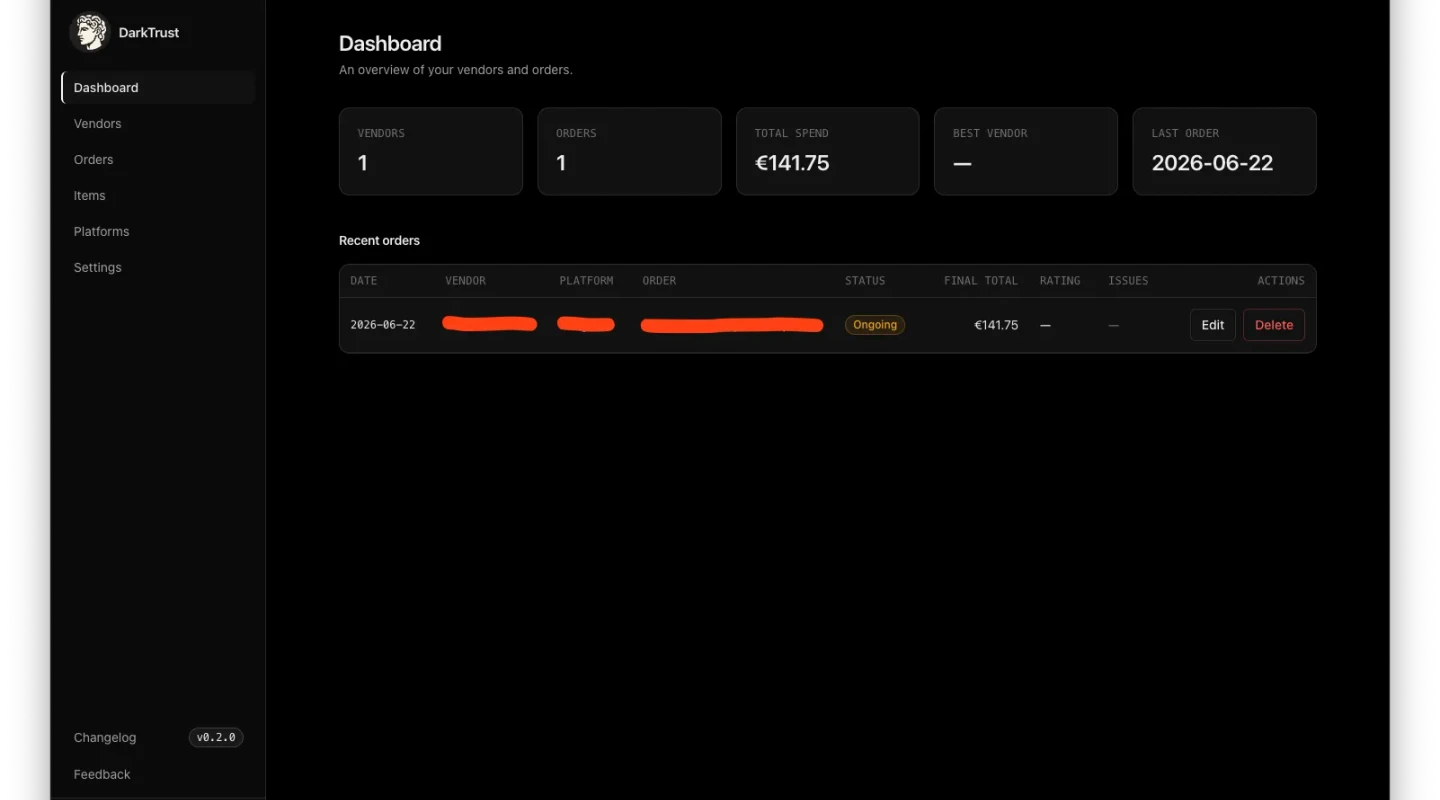
The problem: too many orders, not enough memory
We all know the feeling. You order something online and then you wait. Sometimes the package shows up right on time, and sometimes it takes forever. That part I can live with. The real problem for me was remembering anything about my orders afterwards: what I bought, in what quantity, and from which vendor.
After a while it all blurs together. Some orders arrived exactly as promised; others were nothing like the listing, with the wrong item, the wrong amount, or a vendor who had clearly oversold what they offered. On the kind of marketplaces I'm talking about, there's no support line to call and no buyer protection to fall back on, so the only thing keeping you safe is knowing who's reliable and who isn't. My memory was no help there, and more than once I ended up ordering again from someone who had already let me down. That's what pushed me to build DarkTrust.
What DarkTrust does
DarkTrust is the long-term memory I never had for my orders. You create an entry for every order you place and attach all the details that matter: what you ordered, how much of it, which vendor it came from, the shipping they offered, and how much you spent.
You can keep track of vendors, orders, items, offers, and the platforms you bought on. Once an order arrives, you can rate the vendor, note how long delivery took, record how well the package was put together, and add anything else worth remembering for next time. Everything sits in one place, so the next time you're about to order, you actually know who you're dealing with.
Privacy and self-hosting
A tool like this only works if you trust it with sensitive data, so that data stays yours. DarkTrust is open source. If you have a server and Docker, you can self-host it for maximum privacy and security. If you don't, you're welcome to use the hosted version that I run myself.
Everything you enter is strongly encrypted. On your first login you set a recovery key, and that key matters: if you forget both your password and your recovery key, the data is gone for good. There's no backdoor, which is exactly the point. Only your real E-Mail is necessary for the hosted version in case the project/website shuts down I can reach you before that happends and you've the chance to export your data as json. With that then you can host the project yourself and import your data if you want to.
Built in a day with Claude
The whole thing took me about eleven hours, all in a single day. Most of it was written with Claude Code, using Claude Opus 4.8 from start to finish. I even picked up a second paid Pro plan on a separate account so the rate limits wouldn't slow me down halfway through. After this eleven hours the software is already ready to get self hosted or to run on a server with multi tenant support.
It's always interesting to throw a half-formed idea at Claude and see what comes back. If the new Fable model had been available, I'd bet the code could have turned out even cleaner and more concise.
Final thoughts
If some everyday problem keeps nagging at you, think about building your own tool for it. You end up with something shaped exactly around how you see the problem. For me that was a tracker for my online orders, all perfectly legal of course ;) I'm happy with where it is right now, and I hope it nudges a few other people to give it a shot.
Comments
No comments yet — be the first!